Mapping Support

Curricula

Information coming soon!

Trainings

For mapping and GIS trainings, click here.

If you need any pdfs or videos that were previously on this page, please contact Sydnie Matkins at sydnie.matkins@tax.idaho.gov

Additional Opportunities

  • Office Hours: Drop-in office hours are held every Tuesday on Teams from 11-1 MT. The purpose of office hours is for anyone to drop-in and ask questions or discuss GIS-related topics; it is unstructured and open to any GIS topic. A GIS team member is just making themselves available for you to stop by without having to schedule a meeting. Attendance/registration is not required and, of course, you may schedule a meeting with us outside of this time!
  • Mapping Meetings: Semi-structured meetings held quarterly where counties will submit deed and GIS topics for discussion prior to the meetings. The State GIS Education lead will compile all responses and prepare a short video demo on a topic of choice. The meeting will be similar to a round table, where we will discuss the submitted questions and then walk through the demo. For previous meetings, click here.
  • Short Videos: Please visit our YouTube Channel for short how-to videos.
 
If you are interested in being notified of these meetings or would like more information, please contact Sydnie Matkins at sydnie.matkins@tax.idaho.gov.

Additional Education Information

Links take you to Property Tax Education pages

For more information, please contact the Education Director, Jeff Middleton jeffrey.middleton@tax.idaho.gov

Data & Maps

Interactive Maps

Visit interactive map websites

Open Data

ESRI Open Data Download Portal

Taxing Districts

A taxing district is any entity or unit with the statutory authority to levy a property tax. The areas covered by these districts may overlap and change every year.

In Idaho property taxes are collected by the County and distributed to each taxing district (schools, cities, county agencies, fire districts, road districts, etc.) in which the property lies. The amount of property tax that you pay is based on

  1. The assessed value of your property and
  2. Tax rates and bond debt service amount your taxing districts levy.

Additional Resources

Maps and Data

You may download current and historic taxing district data (shapefiles) using the table below. Search by year and district type. A table should appear, from which you can download a shapefile or map.

Boundary changes do not take effect until the year following the year it was submitted. For example, requests submitted to ISTC during calendar year 2026 will take effect in calendar year 2027.

PDF maps stopped being produced for individual taxing districts in 2022. If you need a map for an individual taxing district, please contact us at gis@tax.idaho.gov.


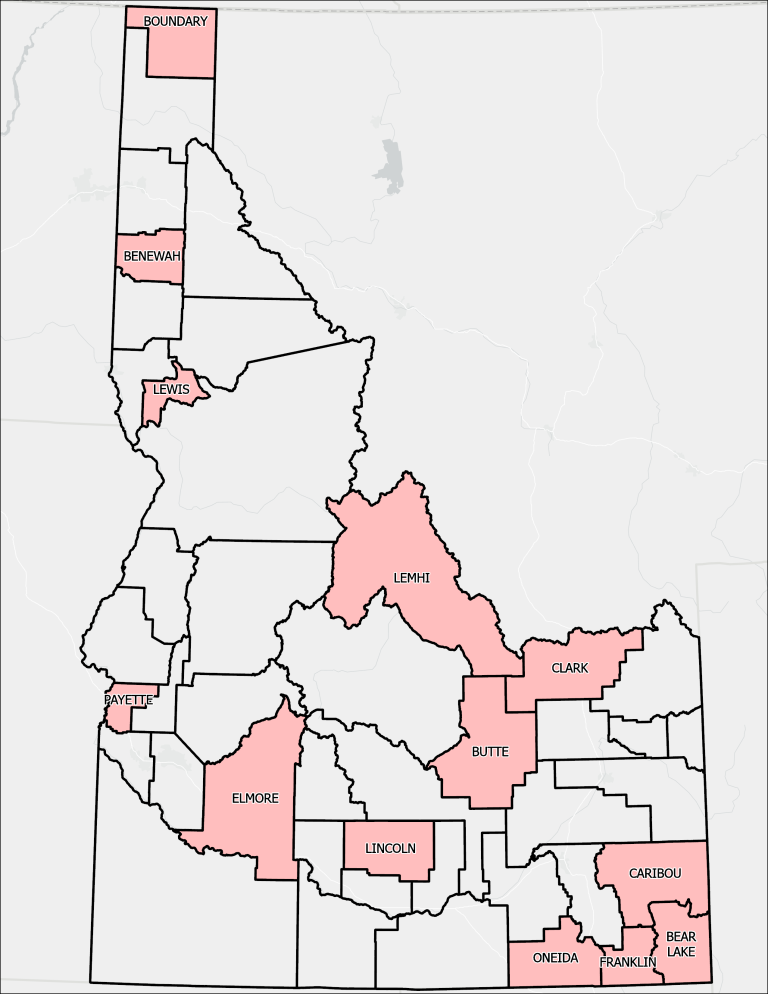
The following counties had no district boundary changes for the 2026 tax year.

Tax Code Areas (TCAs/TAGs)

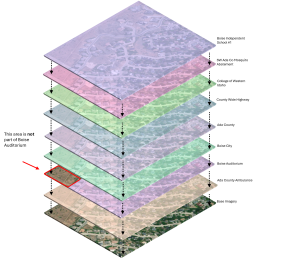
A Tax Code Area (TCA), or Taxing Authority Group  (TAG), is a unique combination of overlapping taxing districts. Each TCA is given a levy rate based on the taxing districts it encompasses; property tax is calculated by multiplying the assessed value of the property by the levy rate.

A TCA does not need to be contiguous and can occur separately in various parts of a county. However, TCAs only occur within a single county’s boundaries; the same TCA number found in different counties are referencing a different combination of taxing district.

Example:

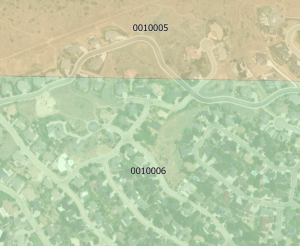
Below is a visual representation of a subsection of TCA 001-0006 in eastern Boise, Ada County. TCA 001-0006 contains 8 taxing districts that overlap in space. If we were to travel slightly north, we would be outside of Boise Auditorium’s boundary and thus be within TCA 001-0005.

NOTE: TCA 001-0006 in Elmore County (or any county other than Ada) does not contain any of the same districts as below.
Data

Search below by year and county for:

  • List of Changes (LOC): lists each change in a county’s map (i.e., audit, annexation, de-annexation, correction, creation, dissolution, etc.) – showing area affected and TCA change
  • Description of Numbers (DON): lists all TCAs by number for each county and which districts are found in each TCA
  • TCA maps by City (not available for 2023 – present)

DONs and LOCs are published each year around March.

Selecting the County as “Statewide” will return statewide annexation and TCA shapefiles (not available every year).


Contact Us

  • GIS Manager: email Paul Reyes or call (208) 334-7718
  • GIS Analyst Senior (Tax Code Area/Annexations): email Josh Cruz or call (208) 334-7743
  • GIS Analyst Senior (Tax Code Area/Annexations): email Jennifer Williams or call (208) 334-7752
  • GIS Analyst (Mapping Support and Education): email Sydnie Matkins or call (208) 334-7737

Reach us at gis@tax.idaho.gov or by fax at (208) 334-7629.

Physical Address: 11321 W Chinden Blvd, Boise, ID 83714 Building 2

Mailing Address: P.O. 36 Boise, Idaho 83722-0410

Homeowners Guide

Counties tax land and homes (including manufactured housing) to provide local services and support for independent taxing districts, such as cities and schools.

Read more in our Understanding Property Tax guide, including how your property tax assessment is determined and what to do if you disagree with it.

Tax relief for homeowners

You might be eligible for one or more of the following programs. Read the descriptions below to see if you could qualify.

Homeowner’s exemption

If you own and occupy a home (including manufactured homes) as your primary residence, you could qualify for a homeowner’s exemption for that home and up to one acre of land.

Learn more on the Property Tax Homeowners Exemption page.

Property tax reduction program

This program can reduce the property tax you must pay on your home and up to one acre of land. You must apply every year between January 1 and April 15 with your county assessor’s office.

You can find forms and a brochure describing eligibility requirements on the Property Tax Reduction page.

Property tax deferral program

The program lets you postpone paying taxes on your home and up to one acre of land. You must apply every year between January 1 and the first Monday in September with your county assessor’s office.

Like the Property Tax Reduction program, you must meet specific eligibility requirements. Read more on the Property Tax Deferral page.

Benefit for veterans with a 100% service-connected disability

This program can reduce the property tax you must pay on your home and up to one acre of land. You must apply every year between January 1 and April 15 with your county assessor’s office.

You can find forms and a brochure describing eligibility requirements on the 100% Service-Connected Disabled Veterans Benefit page.

Other property tax resources

You can find other property tax pages on the Property Tax Hub.

The Tax Commission doesn’t collect property tax. Counties collect property taxes. The Tax Commission just oversees the property tax system to ensure compliance with state laws. Read more in our Understanding Property Tax guide.

History of maximum homeowner's exemption

YearsMaximum
1980-1982$10,000
1983-2005$50,000
2006$75,000
2007$89,325
2008$100,938
2009$104,471
2010$101,153
2011$92,040
2012$83,974
2013$81,000
2014$83,920
2015$89,580
2016$94,745
2017$100,000
2018$100,000
2019$100,000
2020$100,000
2021-2025$125,000

Homeowner’s Exemption

If you own and occupy a home (including manufactured homes) as your primary residence, you could qualify for a homeowner’s exemption for that home and up to one acre of land.

You apply for this exemption with your county assessor’s office, and it determines if you qualify. Once approved, your exemption lasts until the home’s ownership changes or you no longer use the home as your primary residence.

The homeowner’s exemption will exempt 50% of the value of your home and up to one acre of land (maximum: $125,000) from property tax.

History of maximum homeowner’s exemption

YearsMaximum
1980-1982$10,000
1983-2005$50,000
2006$75,000
2007$89,325
2008$100,938
2009$104,471
2010$101,153
2011$92,040
2012$83,974
2013$81,000
2014$83,920
2015$89,580
2016$94,745
2017$100,000
2018$100,000
2019$100,000
2020$100,000
2021-2025$125,000

Property Tax Reduction

You might be eligible for the Property Tax Reduction program if you’re an Idaho resident and homeowner. The program could reduce your property taxes by $250 to $1,500 on your home and up to one acre of land.

Note: This program won’t reduce solid waste, irrigation, or other fees that government entities charge.

Read more about this program:

County assessors and the Tax Commission manage this program. If the guide above and this page don’t answer your questions, contact your county assessor’s office or call us at (208) 334‑7736.

Who qualifies

You might qualify for this program in 2027 if all of these apply:

  • Your total 2026 income, after deducting medical expenses, was $40,030 or less.
  • You were 65 or older, blind, widowed, disabled, a former POW or hostage, or a motherless or fatherless child under 18 years old.
  • You owned and lived in a home in Idaho that was your primary residence before April 15, 2027.
    • The property must have a current homeowner’s exemption.
    • The home can be a mobile home.

You could qualify if you live in a care facility or nursing home in 2027 or lived in one in 2026. Contact your county assessor’s office for information

Applying

You must apply and qualify for this program every year. You must apply between January 1 and April 15, 2027, for a reduction to 2027 property taxes.

If your application’s approved, your benefit will appear on your December 2027 property tax bill.

Before you apply: See the guide for the 2027 Property Tax Reduction Program for the information you’ll need to have ready.

Contact your county assessor’s office or call us at (208) 334‑7736 if you need help. 


Alternately, you can fill out and mail a paper form to your county assessor. Contact your assessor’s office for the form or download it here:

  •  2026 Property Tax Reduction, Application
  •  pdf Property Tax Reduction, Application Instructions

Other forms

You’ll need the information on the Medical Expense Statement below to apply. You might also need the other forms.

Other tax relief options

You might also qualify for these tax relief programs:

Laws and rules

Idaho Code section 63-7 — Property Tax Relief

Property Tax Deferral

You might be eligible for the Idaho Property Tax Deferral program if you’re an Idaho resident and homeowner. The program lets you postpone paying taxes on your home and up to one acre of land. You must pay the taxes and interest later.

Note: This program won’t defer solid waste, irrigation, or other fees that government entities charge.

Read more about the Property Tax Deferral program:
2027 Property Tax Deferral program.

County assessors and the Tax Commission manage this program. If the guide above and this page don’t answer your questions, contact your county assessor’s office or call us at (208) 334-7736.

Who qualifies

You might qualify for this program in 2027 if both of these apply:

Applying

You must apply and qualify for this program every year. You must apply between January 1 and September 7, 2027, for a deferral on your 2027 taxes.

If your application’s approved, we pay the county directly. You won’t see the deferral on your property tax bill.

Before you apply: See the guide for the 2027 Property Tax Deferral program for the information you’ll need to have ready

For help, contact your county assessor’s office or call us at (208) 334-7736.

Other tax relief options

You might also qualify for these programs:

Laws and Rules

Idaho Code section 63-7 — Property Tax Relief

Property Tax Benefit for Disabled Veterans

You might qualify for this program if you’re an Idaho resident, homeowner, and qualified veteran with a 100% service-connected disability. The program could reduce the property taxes on your home and up to one acre of land by as much as $1,500.

Once granted to a qualifying veteran, a surviving spouse can use this benefit. However, the benefit isn’t transferable to a new property after the death of the veteran.

Note: This program won’t reduce solid waste, irrigation, or other fees that government entities charge.

Read more about the program: 
Property Tax Benefit for Veterans with a 100% Service-Connected Disability

County assessors and the Tax Commission manage this program. If the guide above and this page don’t answer your questions, contact your county assessor’s office or call us at (208) 334-7736.

Who qualifies

The Disabled Veterans benefit doesn’t have an income limit. You might qualify for this program in 2027 if both of these apply:

  • You’re recognized as a veteran with a 100% service-connected disability or receive 100% compensation due to individual unemployability by the U.S. Department of Veterans Affairs as of January 1, 2027.
  • You owned and lived in a home in Idaho that was your primary residence before April 15, 2027.
    • The property must have a current homeowner’s exemption.
    • The home can be a mobile home.

You could qualify if you live in a care facility or nursing home in 2027 or lived in one in 2026. Contact your county assessor’s office for information.

         100% Service-Connected Disabled Veterans Property Tax Benefit, Application


Applying

You must apply and qualify for this program every year. You must apply between January 1 and April 15, 2027, for a reduction to 2027 property taxes.

If your disability is permanent and total, you don’t need to reapply each year. The benefit will renew automatically.

If your application’s approved, your benefit will appear on your December 2027 property tax bill.

Before you begin: Get a current letter from the U.S. Department of Veterans Affairs confirming your 100% service-connected disability rating or your 100% compensation due to individual unemployability as of January 1, 2027.

Contact your county assessor’s office or call us at (208) 334-7736 if you need help.


Alternately, you can fill out and mail a paper form to your county assessor. Download it here:  Disabled Veteran Property Tax Benefit Application

Other tax relief options

You might also qualify for these tax relief programs:

Laws and rules

Idaho Code section 63-7 — Property Tax Relief